








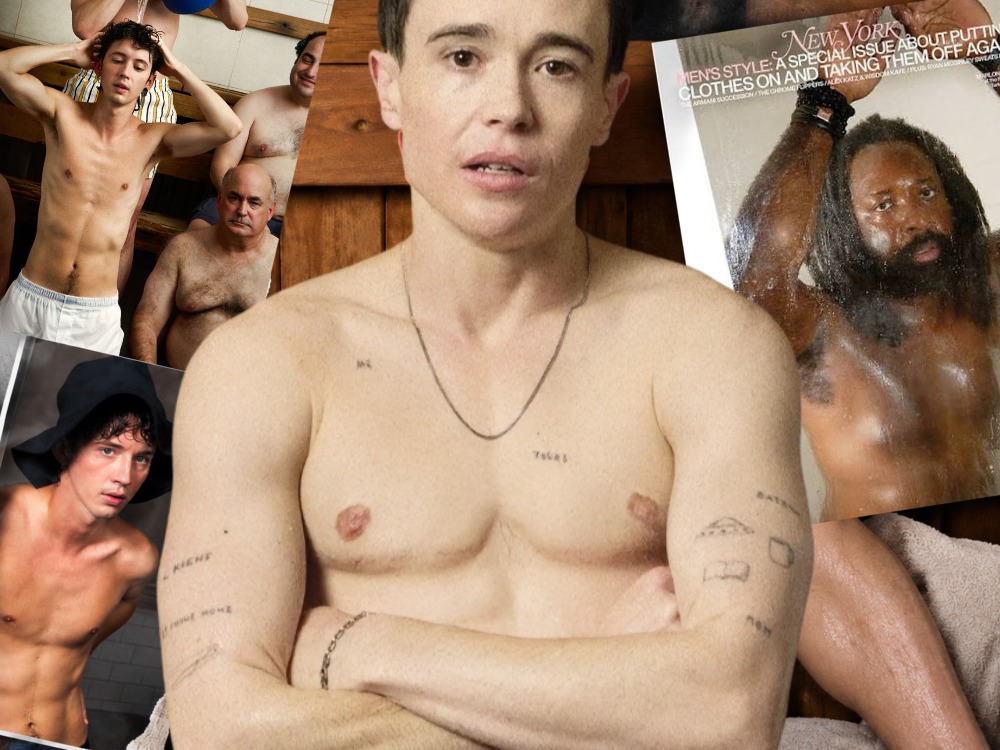

Elliot Page, Troye Sivan, Marlon James and Jeremy O. Harris are among the queer stars turning up the heat in New York Magazine’s first-ever Men’s Style issue.
The special portfolio, titled The Boys in the Baths, was photographed by Ryan McGinley inside Manhattan’s historic Russian & Turkish Baths, bringing together actors, musicians, writers, performers and artists for a steamy celebration of contemporary masculinity.
Page appears as one of the issue’s most prominent faces, shirtless and relaxed in a setting that puts bodies, gender and male intimacy firmly at the centre.
For a trans man who has spoken so openly about finally feeling at home in his body, the imagery carries an obvious resonance.
Elliot Page On Feeling Comfortable In His Body
Page has previously spoken about the freedom he has found since transitioning, and the bathhouse setting gives that conversation a very physical context.
In the issue, he reflects on recently visiting a bathhouse himself.
“I went to a bathhouse recently,” Page says.
“I’ve only in the past couple of years been like, Yeah, that sounds nice, to, like, go somewhere and sit around in your body like that.”
It is a simple comment, but one that feels significant given how candid Page has been about dysphoria, transition and learning to feel comfortable in his own skin.
In 2021, he became the first openly trans man to appear on the cover of TIME, and he has since become one of the world’s most visible trans actors.
This latest shoot places him within another traditionally gendered space: a mainstream fashion issue about men, masculinity and style.
No explanation required.
He is simply there.
Troye Sivan, Marlon James And More Queer Talent
Page is far from the only LGBTQ+ name featured.
Australian pop star Troye Sivan, Booker Prize-winning novelist Marlon James, actor Brandon Flynn and playwright and performer Jeremy O. Harris are among the queer men photographed for the portfolio.
The wider group includes creatives working across music, theatre, film, fashion, art and dance.
That mix feels particularly fitting for an issue attempting to examine what men’s style and masculinity look like in 2026.
Rather than presenting one narrow model of masculinity, the portfolio makes room for men whose identities, bodies, sexuality and creative work sit across a much broader spectrum.
Inside New York’s Oldest Bathhouse
The shoot took place at the Russian & Turkish Baths, an East Village institution operating since 1892.
Over more than a century, the venue has attracted an eclectic mix of New Yorkers, from artists and actors to neighbourhood regulars.
It has also developed its own place within New York’s queer social history.
The baths have long offered men-only hours alongside mixed-gender sessions, creating spaces where gay men have socialised alongside the venue’s broader clientele.
That makes the setting for The Boys in the Baths more than an aesthetic choice.
Bathhouses have played an important role in gay male history, providing spaces for community, intimacy, sex and freedom at times when openly queer social life was far more restricted.
New York’s bathhouse culture has changed dramatically over the decades, but the imagery still carries that history.
Jeremy O. Harris Has Thoughts About Steam-Room Etiquette
Naturally, not everyone featured was approaching the bathhouse with complete seriousness.
Jeremy O. Harris used the opportunity to identify one modern steam-room habit he would happily see disappear.
“Young men who are obviously sort of like on a no-homo tip, very much in finance, wearing full socks and shoes in the steam room with their gym shorts,” he said.
He also questioned people wearing headphones in the steam room.
“Like, actually take in the sounds,” Harris said. “There are really interesting sounds in a steam room.”
Noted.
Masculinity Without The Narrow Rules
What makes the issue particularly interesting for queer audiences is not simply the number of LGBTQ+ men involved.
It is the way the portfolio treats queer and trans masculinity as part of masculinity itself, rather than as a separate category requiring explanation.
Page’s inclusion feels especially powerful in that regard.
Trans bodies are frequently discussed in political and medical terms, often by people who are not trans themselves.
Here, Page’s body is not being debated.
It is being photographed, styled and celebrated.
For a first Men’s Style issue, that feels like a pretty good place to start.
Focus Keyphrase:
Meta Description: