









Older Takatāpui and Rainbow New Zealanders experience abuse at almost twice the rate of the general older population, with new research exposing family rejection, discrimination in aged care and people being forced back into the closet.
Almost one in three older Takatāpui and Rainbow New Zealanders has experienced abuse within the past year, according to new research highlighting serious shortcomings in how the country protects its ageing Rainbow communities.
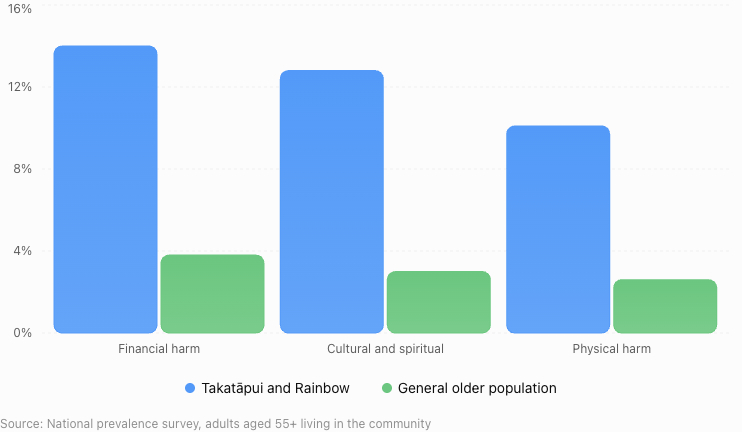
Figures from a national survey of people aged over 55 living in the community found that 32.4% of Takatāpui and Rainbow respondents experienced harm in the previous 12 months, compared with 16.4% of the general older population.
The findings are highlighted in a major new report released on Thursday 22 October by Hohou Te Rongo Kahukura and the University of Auckland.
Commissioned by the Ministry of Social Development, Prevention of the Abuse of Takatāpui and Rainbow Older People examines the particular forms of harm experienced by older Rainbow New Zealanders, drawing on national and international research, policy analysis and interviews with ten community experts.
It paints a troubling picture of people being denied access to their partners, rejected by their families, mistreated in aged-care settings and left dependent on those who abuse them.
Sandra Dickson, Tauiwi Research Lead for Hohou Te Rongo Kahukura, says the experiences described by community experts demonstrate the urgency of the problem.
“Our older people are being forced back into the closet, or never getting the chance to leave it. There is an urgent need for systemic changes to make sure Takatāpui and Rainbow older people can age with dignity, and be safer in healthcare, aged-residential care and social services.”
Four Times the Rate of Financial and Physical Harm
The figures reveal particularly concerning disparities in specific forms of abuse.
Financial harm was reported by 14% of older Takatāpui and Rainbow people, compared with 3.8% of the general older population.
Cultural and spiritual harm affected 12.8%, compared with 3%, while physical harm was reported by 10.1%, compared with 2.6%.
Each occurred at approximately four times the rate experienced by the wider older population.
Researchers say the disproportionate levels of abuse cannot be separated from a lifetime of discrimination, marginalisation and exclusion.
For generations who grew up when homosexuality was criminalised, the effects of earlier rejection can continue well into old age, shaping their relationships, financial security and willingness to seek help.
The report also identifies how historic discrimination can leave older Rainbow people isolated, sometimes making them dependent on family members or support workers who treat them poorly.
Family Rejection and a Return to the Closet
Ana Tashkoff, Kaiārahi Rangahau Takatāpui at Hohou Te Rongo Kahukura, says family rejection emerged repeatedly throughout the research.
“That history of being treated as criminals is still relevant for our kaumātua – many are still carrying that lifelong mamae.”
Some older people who came out earlier in life had been estranged from their families for decades. Others who came out later faced rejection from their adult children.
“We heard that those who came out earlier in their lives were often estranged from their whānau, who might have kicked them out of home as rangatahi. But we also heard that people coming out later in life were often rejected by adult children, or stopped from seeing their mokopuna unless they went back into the closet.”
The full report also identifies situations where families refuse to recognise Rainbow relationships, exclude partners from funeral arrangements or end-of-life decisions, or pressure older people to conceal their identities in residential care.
Researchers warn that identity-based abuse can be especially difficult to recognise when it occurs within families or institutions that an older person depends upon.
Falling Through the Gaps
One of the report’s most significant findings is that older Rainbow people can face exclusion from both mainstream aged-care services and their own communities.
Services for older people often assume their clients are heterosexual and cisgender, while Rainbow organisations have historically placed greater emphasis on supporting children and young people.
“Between Rainbow community groups being mostly focused on rangatahi and tamariki, and older person’s services being mostly focused on straight, non-trans older people, our Takatāpui and Rainbow kaumātua are missing out on the care they need,” Tashkoff says.
The report identifies particular gaps in support for bisexual, transgender and non-binary people, intersex people, people living with HIV and culturally diverse Rainbow communities.
For Takatāpui kaumātua, the research also highlights the enduring effects of colonisation, including the disruption of traditional understandings of gender and sexuality and intergenerational connections.
Researchers argue that services must recognise these different experiences rather than treating older Rainbow New Zealanders as a single, uniform community.
21 Policies Fail to Mention Rainbow Older People
The report also reveals how frequently older Rainbow people are overlooked in the policies intended to protect them.
Of 35 key policies examined, 21 made no mention of Takatāpui and Rainbow communities.
Even where they were acknowledged, they were often included only within broader lists of marginalised groups.
“When we do appear, it’s most likely to be in a list of communities that are not well-served. We need to do better,” Dickson says.
The report makes 24 recommendations, including establishing dedicated community-led abuse prevention services, improving Rainbow competency training for healthcare and housing professionals, strengthening independent complaints processes and investing in kaupapa Māori and culturally specific services.
It also calls for better government leadership, data collection and recognition of older Rainbow people within national ageing and health policies.
For researchers, the message is clear: ensuring Takatāpui and Rainbow New Zealanders can age safely requires more than acknowledging discrimination. It means creating services where their identities, relationships, cultural connections and dignity are actively respected.
Read the full report, Prevention of the Abuse of Takatāpui and Rainbow Older People, at Hohou Te Rongo Kahukura.
If you or someone you know is experiencing abuse, free and confidential support is available through the Elder Abuse Response Service on 0800 326 6865. If someone is in immediate danger, call 111.