







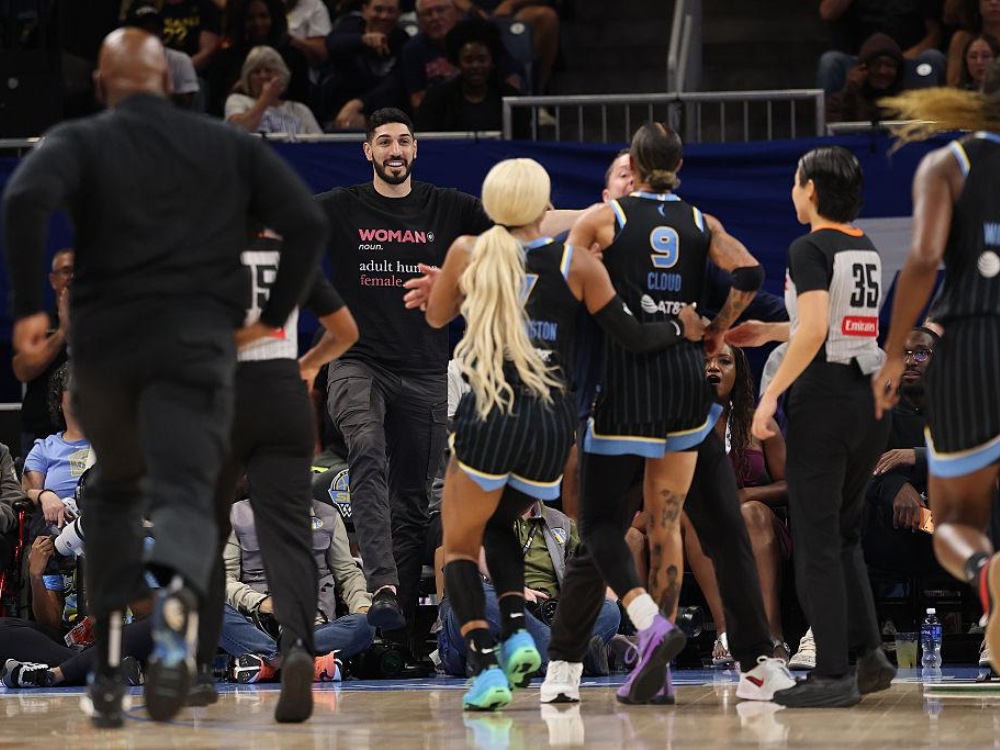

The WNBA has told Republican lawmakers that former NBA players Enes Kanter Freedom and Royce White are ineligible to play in the women’s league, after the pair launched a highly publicised challenge to its rules amid the political debate over transgender athletes.
The WNBA has given its clearest answer yet to two former NBA players attempting to force the league into defining who qualifies as a woman.
In a letter dated 16 October, commissioner Cathy Engelbert told members of Congress that Enes Kanter Freedom and Royce White are not eligible to play in the WNBA.
“With respect to your questions regarding eligibility, only women are eligible to play in the WNBA, and the individuals you cite in your letter are both men,” Engelbert wrote.
The response followed a September inquiry led by Republican Indiana representative Marlin Stutzman, who, alongside four Republican colleagues, asked the league to explain how it determines eligibility under its collective bargaining agreement.
Engelbert’s letter settles the WNBA’s position on these two men.
It does not, however, establish a detailed league-wide definition covering transgender athletes.
Why did Freedom and White say they wanted to join the WNBA?
Earlier this year, Freedom and White publicly announced plans to enter the 2027 WNBA Draft, while saying they identified as women in the context of their eligibility challenge.
Their own comments make clear that the announcements were intended to challenge the league’s rules around sex and gender rather than document a personal transition.
White has since agreed when asked whether his declaration was made “for basketball purposes”, while Freedom has repeatedly said his aim is to pressure the WNBA into restricting its women’s category explicitly on the basis of biological sex.
That distinction matters.
Their campaign should not be treated as representative of transgender athletes who genuinely live and compete according to their gender identity.
Instead, the pair have deliberately inserted themselves into an already contentious policy debate in an effort to test — and potentially change — the WNBA’s eligibility framework.
What do the WNBA rules actually say?
The league’s current collective bargaining agreement contains a straightforward sentence:
“Only players who are women are eligible to play in the WNBA.”
But reporting on the agreement notes that it does not contain more detailed language specifically addressing gender identity or sex assigned at birth.
That gap is what Freedom, White and Republican lawmakers have focused on.
Stutzman’s congressional letter asked the WNBA to provide a more explicit definition of “women” and explain why Freedom and White had been ruled ineligible.
Engelbert answered the second question.
She did not fully answer the first.
WNBA previously condemned ‘bad-faith’ debate
The league had already pushed back strongly against the controversy surrounding Freedom and White.
In August, after the former NBA players announced their plans, a WNBA spokesperson said:
“There are no immediate eligibility matters affecting the WNBA, and we strongly denounce the bad-faith efforts to use these topics to demean or marginalize others.”
The Women’s National Basketball Players Association also said at the time that players supported justice, equity, diversity and inclusion, while insisting they would not be used as “political pawns”.
Engelbert later said outsiders were attempting to use the league to “sow divisiveness” and turn the WNBA into a political battleground.
Importantly, reporting in August said there were no transgender women currently playing in the WNBA.
The controversy therefore emerged largely around a hypothetical policy question rather than an active eligibility dispute involving a trans WNBA player.
Freedom accuses commissioner of ‘misgendering’ him
Freedom has rejected Engelbert’s response.
Speaking to OutKick after the letter became public, he argued that the commissioner could not simply classify him as a man without explaining the standard used.
“You cannot answer an eligibility question simply by declaring what somebody is,” he said.
“You need to explain the policy you are enforcing.”
Freedom also told the outlet that he considered Engelbert’s description of him as a man to be misgendering.
That statement sits awkwardly alongside his own framing of the campaign as a deliberate challenge intended to establish sex-based eligibility rules.
The WNBA, meanwhile, has made no suggestion that it considers Freedom’s declaration to represent the same circumstances as a transgender woman seeking to participate in sport according to her gender identity.
Royce White threatens legal challenge
White has taken the dispute a step further.
Following Engelbert’s letter, he said he would explore possible legal action against the league.
“We plan to explore every legal avenue possible to hold the WNBA and NBA community to their stated standards and values,” White told OutKick.
As of 20 October, however, White had not announced that a lawsuit had actually been filed.
He continued to argue that the league should explain how it defines men and women and called on NBA commissioner Adam Silver to address the dispute as well.
A debate much bigger than two former NBA players
The episode comes as transgender participation in women’s sport remains a major political issue in the United States.
Some athletes and politicians support policies requiring women’s sporting categories to be determined solely by sex, while others argue that blanket exclusions of trans athletes can be discriminatory and should instead account for factors such as the sport, level of competition and relevant medical or regulatory frameworks.
Within the WNBA itself, players and coaches have expressed differing views.
Some have supported tighter restrictions on transgender participation, while others — including prominent players and coaches — have publicly supported trans inclusion.
That disagreement is substantially different from the Freedom and White campaign.
Their attempt to enter the draft was designed specifically to expose what they see as inconsistency in the league’s rules.
It was not prompted by either player publicly describing a longstanding transgender identity or transition.
So what has the WNBA actually decided?
For now, the position is narrower than some headlines might suggest.
The WNBA has said:
Freedom and White are men, and therefore cannot play in the league.
It has not announced a new transgender eligibility policy.
It has not amended its collective bargaining agreement.
And it has not publicly issued the wider definition of “women” sought by Republican lawmakers.
The league has said it will continue discussing transgender participation with teams and players.
That leaves the broader policy question unresolved.
But when it comes to Enes Kanter Freedom and Royce White, the WNBA’s answer could hardly be clearer.
They are not eligible.