






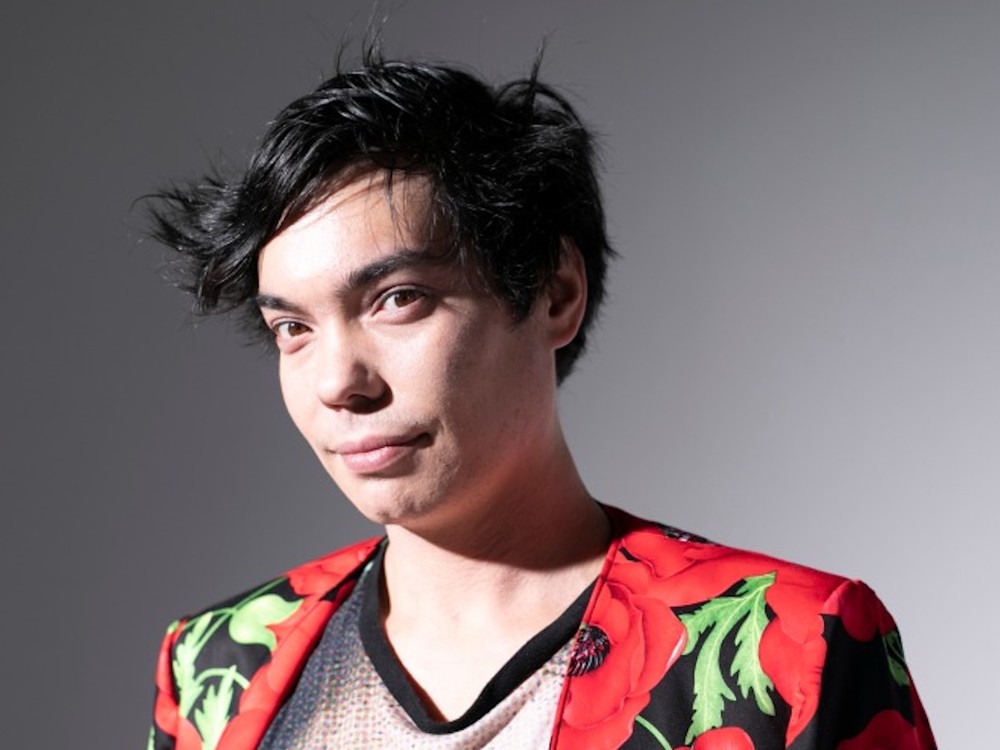

From his first nerve-racking performance to his 54th play, Sam Brooks has learnt a thing or two about words, connection and making every moment count.
When playwright Sam Brooks stepped onto the stage in 2015, the words were his own in more ways than one. Stutterpop, an autobiographical mix of storytelling and lip-synching, was the first time he had performed in front of an audience. It came just months after his mother died.
“That period in my life is such a weird haze for me,” he remembers. “I have very little memory of that first production, and only a few of the second time we did it.”
At Auckland’s Basement Theatre, the show challenged audiences to experience speech differently. An YOUR EX review at the time described a performance that ran well beyond its allotted time, with pauses becoming as significant as the words between them.
Brooks remains unsure exactly why he made it. “Maybe it came from me really fucking hating The King’s Speech. Maybe I just wanted to put that story out into the world.”
A Warped Experience Of Time
More than a decade later, his reflections on stuttering are remarkably precise.
“It’s made me very thoughtful with what I say, because of the effort it takes. It’s also completely warped my experience of time.”
Although he is more fluent than in his teens and twenties, a momentary block can still feel interminable. “A block for me feels like half a minute in my brain when in ‘reality’, it’s only a few seconds.”
It’s an intriguing perspective from someone who has devoted his career to words. And he has written plenty of them.
54 Plays And Counting
Brooks has written 54 plays, with nearly half of them having been staged in New Zealand. His credits include Riding in Cars with (Mostly Straight) Boys, Burn Her and A Rich Man. He won the Bruce Mason Playwriting Award in 2016 and holds the record for the most plays shortlisted for the Adam NZ Play Award at 17.
But finishing a script doesn’t mean it deserves a production. Some belong to an earlier version of himself, while others simply aren’t worth the immense effort involved in getting a play onto a stage.
“Sometimes you get to writing ‘END’ and go, ‘Oh yep, maybe that was not worth all the effort.’ But hey, if someone wants to stage them, go ahead.”
What still surprises him is that audiences choose to spend an evening with his work.
“There are so many ways people can spend their time in the modern world, and that people want to take a chance on it is a true thrill, blessing and privilege.”
A Genuinely Uneventful Coming Out
Brooks has often explored queer lives and relationships on stage, but his own coming-out story is spectacularly undramatic, describing it as “genuinely uneventful,” and his childhood was “broadly happy”, with plenty of love and support. His twenties, he hints, were another story.
Nor does he describe himself as particularly anchored to a queer community. He has never quite felt he belonged to one, but never felt excluded either. That leaves him free to move between different circles, comfortably distant from their internal politics.
He believes approaching others with warmth, curiosity and grace generally serves you well, before adding a characteristically self-aware caveat: “But I might have my blinkers on!”
All You Had Was Fun
His latest play, All You Had Was Fun, turns towards friendship, grief and the passage of time. Written and directed by Brooks, it follows four friends gathering in the same room at different points in their lives. There is pizza, wine and an absence nobody can quite escape. The scenes repeat, but the people and their relationships shift.
The production transforms Q Theatre’s intimate Vault space, with an experimental structure that invites audiences to pay close attention to what changes, and what remains unsaid. It’s a fitting next project for a writer so attuned to the significance of what people say, and what they don’t.
What He Values Most
Away from the theatre, his ambitions are disarmingly simple. He likes to be “thoughtful”, and would be perfectly happy spending his days writing at a laptop or notebook, or working in a rehearsal room.
His ideal Auckland weekend is equally understated: “A bottle of good sav, two books, maybe a video game nobody has heard of, and some podcasts I am too embarrassed to put in print that I am a paid subscriber of.”
The prolific playwright, it seems, knows the pleasures of doing very little.
But what he values most is something no award or opening night can provide. His answer brings us back to the way he experiences the world, the people he has lost and what it means to give someone your full attention.
“What I value most in life is time. Too many people I’ve known have not had the time to do what they could have achieved, so I’m very conscious about valuing my own time and the time of others. If I’m in front of you, I’m in front of you 100%.”
All You Had Was Fun plays Q Theatre’s Vault from 18–29 November. Tickets at qtheatre.co.nz.