











‘The Untouchable Girl Who Helped Aotearoa See Itself’
For generations of New Zealanders, Dame Jools Topp has been more than an entertainer. For many rainbow Kiwis, she was one of the first openly lesbian women they ever saw welcomed into the nation’s lounge rooms.
As one half of the Topp Twins, alongside her twin sister Dame Lynda Topp, Jools helped create a career that seemed almost impossible on paper: openly lesbian, rural, political, country-singing comedians from the Waikato who became some of the most beloved figures in Aotearoa entertainment. Born in Huntly in 1958 and raised on a Waikato dairy farm, the twins’ story was shaped by family, music, hard work and the rural New Zealand they would later both lovingly celebrate and gently parody.
Jools and Lynda first found their people after leaving home for Christchurch, where they connected with lesbian feminist communities and began to understand the power of making art that was both entertaining and political. At a time when being openly lesbian could cost people work, housing and family, the Topp Twins chose visibility.
By the 1980s, they were busking on Auckland’s Queen Street and taking their songs, jokes and politics around the country. Their music carried the spirit of protest, lending their voices to causes including Māori land rights, the anti-nuclear movement and homosexual law reform. In 1985, they even performed their anti-nuclear anthem “Radiation” at the Beehive.
That is part of what makes Jools Topp’s public life so remarkable. She was never only “out” in the soft-focus celebrity sense. She was out while singing country music. Out while playing to mainstream audiences. Out while pushing political causes that were not yet safe or fashionable. Out before rainbow representation had marketing departments, Rainbow Tick programmes or Pride season brand activations.
The genius of the Topp Twins was that they reached people who may never have thought of themselves as political. They did not lecture from a distance. They arrived in gumboots, with harmonies, characters and an instinctive understanding of Kiwi absurdity. Through Jools and Lynda, audiences met figures such as Camp Mother and Camp Leader, the Bowling Ladies and the immortal Ken and Ken, characters who were funny because they were so recognisable. The twins did not sneer at ordinary New Zealanders; they reflected them back, exaggerated just enough to expose the tenderness, silliness and contradictions beneath the surface.
Their breakthrough television series, The Topp Twins: Do Not Adjust Your Twin-Set, launched in the mid-90s and ran for three seasons, later becoming The Topp Twins. The show brought their characters into homes across Aotearoa and helped cement the twins as mainstream television stars. Jools was not appearing as a token lesbian character written by a straight person. She was there as herself, in control of the joke, the music, the persona and the politics.
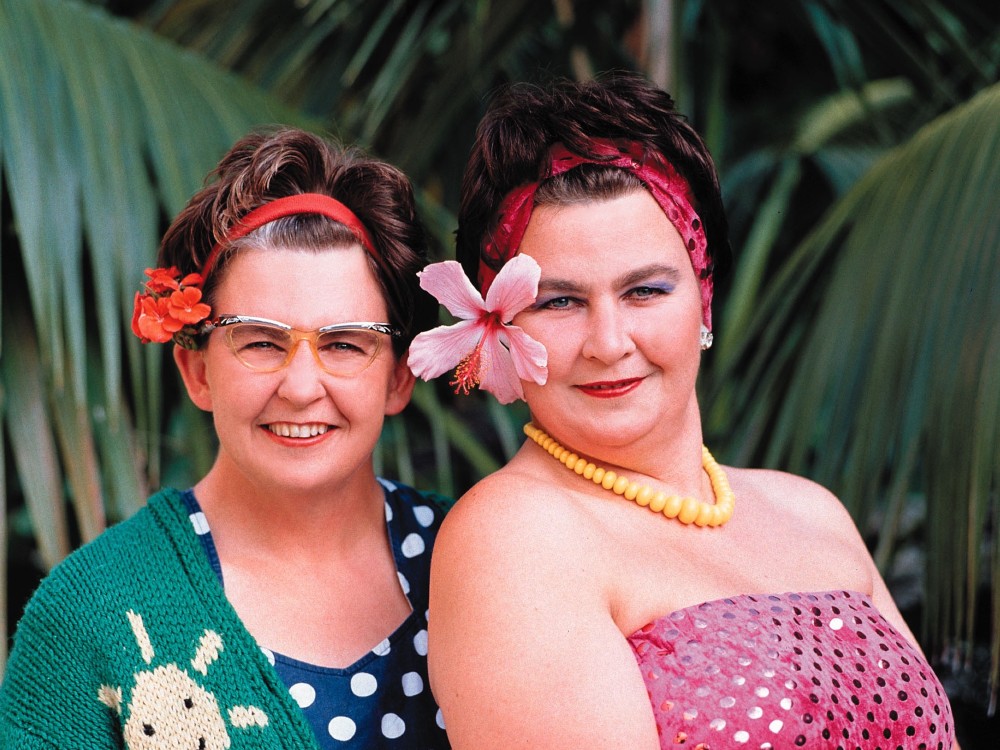
Jools Topp helped make lesbian identity visible in a way that was warm, funny, rural and deeply New Zealand. She challenged the lazy idea that queer life belonged only in cities, nightclubs or imported stereotypes. Her queerness was not separate from the farm, the yodel or the comedy sketch. It was woven through all of it.
The twins’ screen career continued across specials, documentaries and appearances, including In Search of the Lonesome Yodel, which took their love of yodelling on the road through New Zealand and Australia, and Topp Country, their food and travel series celebrating ethical producers, home cooks and communities around Aotearoa. In 2017, Jools and Lynda won Best Presenter: Entertainment at the New Zealand Television Awards for the second season of Topp Country.
Then came The Topp Twins: Untouchable Girls, Leanne Pooley’s acclaimed 2009 documentary, which introduced their story to a new generation and to international audiences. It became a major success for a New Zealand documentary and won awards at festivals including Toronto, Melbourne, Göteborg and Portland.
Jools was diagnosed with breast cancer in the mid-2000s, and later both sisters faced breast cancer diagnoses, a deeply personal experience they have spoken about publicly.
The twins were made Members of the New Zealand Order of Merit in 2004, awarded honorary degrees, celebrated for their contribution to television and entertainment, and in 2018 both Jools and Lynda were appointed Dames Companion of the New Zealand Order of Merit for services to entertainment. In 2026, they were also named as recipients of the Country Music Honour for Contribution to Country Music, a fitting acknowledgement of how deeply their work sits within Aotearoa’s musical landscape.
But honours only tell part of the story. Jools Topp’s real legacy lives in the people who saw her and felt less alone. The young lesbian watching television and realising there was a life beyond secrecy. The rural queer kid who saw someone from the dairy country refuse to become smaller. The older rainbow New Zealander who remembers what it meant to have public figures stand up for homosexual law reform before acceptance was guaranteed. The straight families who laughed along, not always realising that laughter was gently moving them towards familiarity, acceptance and affection.
Jools Topp helped change the emotional weather of this country. She did it without sanding off her edges, without hiding her politics and without abandoning the communities that made her. She showed that lesbian visibility could be joyful, mischievous, stubborn and mainstream, all at once.
For YOUR EX readers, her life and career deserve to be understood not only as entertainment history, but as rainbow history. Jools Topp walked onto New Zealand stages and screens as herself long before it was easy. She gave us songs to sing, characters to quote, causes to rally behind and a version of queer public life that was unmistakably ours.
Dame Jools Topp is not just a national treasure. She is one of the reasons more of us could imagine being treasured by the nation too.