









Olympic figure skater Tim Koleto has opened up about being subjected to conversion therapy, his decision to come out publicly, and why bisexual visibility in sport matters.
Koleto, who was born in Colorado Springs, had long dreamed of competing at the Olympic Games. At 21, while preparing to move to Michigan and begin a new chapter in ice dance, he was told to visit a family friend who would pray over him before he left.
“I was told, ‘They’re going to pray over you’ — bang the champagne against the ship, and then you go off into the sunset,” Koleto told Outsports, reflecting on the 2013 encounter.
“So I go over there, and it’s this woman. The second I sit down, she looks at me and says, ‘You have a homosexual target on your back.’”
Koleto, who had grown up in an evangelical Christian community, said the comment immediately triggered fear.
“I’d been programmed in my religion that this is wrong and impure, something that needs to be prayed away, like a perversion.
“She tells me, ‘I’m not strong enough to pray over you myself, and I can tell that your father wasn’t in your life. I’m going to call my husband, who is also a priest, and he’s going to come and pray over you.’
“So she brings her husband in. They put their hands on me and ‘pray it out’ of me, before sending me on my way.”
At the time, Koleto says he did not fully process what had happened. Instead, the experience slipped into his subconscious alongside other messages he had absorbed suggesting that being gay or bisexual was something to be rejected or “fixed”.
Years later, while preparing for the Beijing 2022 Winter Olympics, Koleto began sessions with a psychotherapist in Montreal, where he still lives. When he mentioned the Colorado Springs incident, his therapist identified it as conversion therapy.
“My therapist said what happened to me would be illegal in Canada. I had never perceived it before as conversion therapy, and that stuck with me for a while.
“It’s part of why, in 2023, I decided to come out publicly. I had been out privately to my family, friends and my wife for years prior. But I thought there are a lot of kids who have been through something similar.”
Coming out publicly
Koleto first publicly posted about being bisexual at the start of Pride Month three years ago.
His coming out was significant in the world of elite men’s sport, where few male athletes, active or retired, have openly identified as bisexual.
His own private coming-out story began in Michigan, during a group call with his mother and older sister. After the call ended, his phone immediately rang again.
“It was just my sister, without my mom,” he said. “She’s sobbing on the other end. And then she comes out to me.
“She says, ‘I’m so sorry I wasn’t brave enough to tell you sooner.’ And it was a beautiful moment in both of our lives.
“It started a chain reaction of me slowly feeling comfortable, like I didn’t have to keep waiting to figure out if I had to pick one side or the other.
“And my family, despite my father still being extremely religious, ended up doing pretty well for me. I’m quite lucky.”
Koleto says that visibility is vital for young LGBTQ+ athletes, particularly those who feel isolated in sporting environments.
“Maybe they’re skaters going to the rink and feel like they don’t fit in. They’re not that feminine, but they’re not that macho or masculine either,” he said.
“It would have been nice when I was that kid in Colorado Springs, feeling confused and left out, to have had someone to look at and feel some sense of representation.”
Olympic success and queer visibility
Koleto’s skating career has taken him across the world. He has lived on three continents and represented four countries: the United States, Norway, South Korea and Japan.
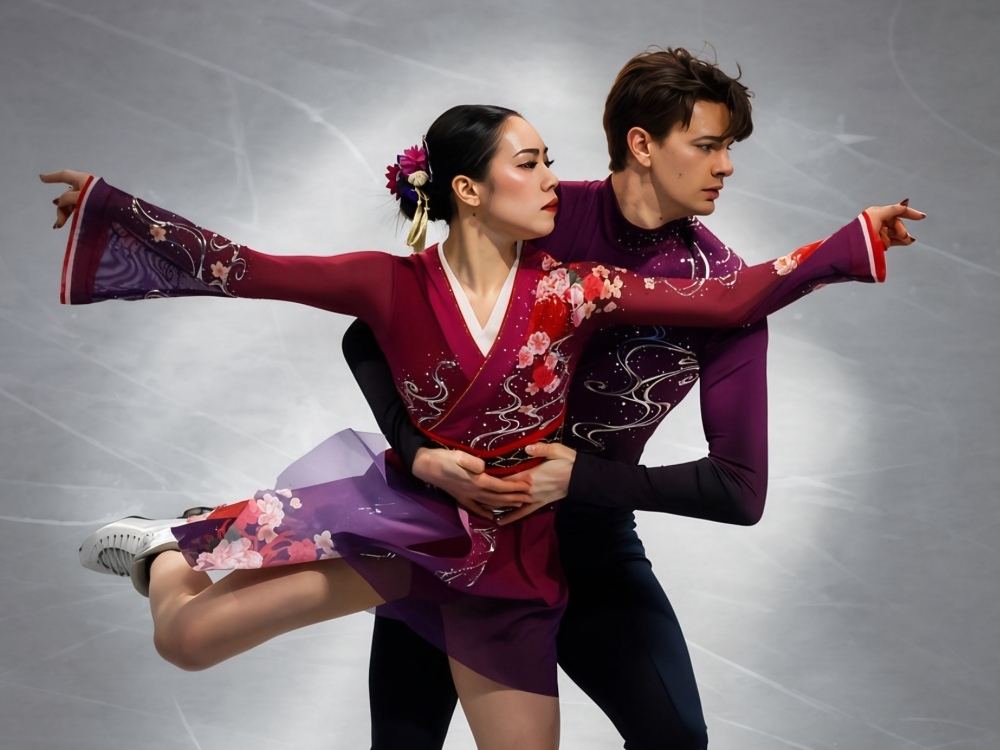
After moving from singles skating into ice dance, he went on to compete at major international events, win national titles, perform at World Championships and earn an Olympic silver medal.
He married his third ice dance partner, Misato Komatsubara, and although the pair have since separated, they have recently skated together again in shows in the United Kingdom and Australia.
Koleto describes receiving his Olympic silver medal alongside Komatsubara and their Japanese teammates as “the pinnacle” of his athletic career.
At Beijing 2022, their rhythm dance included Sylvester’s queer anthem “You Make Me Feel (Mighty Real)”, while their free dance was set to John Williams’ score from Memoirs of a Geisha.
Because of a doping controversy in their event, the medal ceremony was delayed for two years and eventually held during the Paris Games.
“Because there had been a doping controversy in our event, we were invited to receive our medals two years later, at the Paris Games,” Koleto explained.
That delay gave him a different Olympic experience, including the chance to visit Pride House in Paris.
“It also meant I was able to be in the Olympic Village, and I got some of the summer kit, which was really cool! And I could see the Pride House in Paris, which was awesome because in Beijing, we didn’t have any of those resources.
“In many ways, I had a more classic Olympic experience, because Beijing was very closed down in order to run the Games.
“There was also some stigma around queerness in China, whereas in Paris, everything was wide open.
“I hope that openness continues to grow, and I hope to get involved in it in the future.”
Advocacy after retirement
Koleto retired from competitive skating in 2025 and has since been performing, coaching, writing a novel and moving further into advocacy.
Now living in Montreal, he says he has found a greater sense of security, including in his personal life.
“First boyfriend in my whole life! So that’s been an interesting process,” he said with a smile.
He also hopes to contribute to LGBTQ+ conversations in Japan, where he became a naturalised citizen in 2020 and which remains another home for him.
However, he says the cultural context is different.
“It’s not natural to openly share your personal life in any sense. I know with many skaters, you don’t even know they’re dating someone, and then they post about getting married last week, with all the pictures!
“So it’s difficult to know how to support queerness and help them understand that there are resources available to them. I think visibility and honesty are what I can do right now.”
Koleto has also started a Substack alongside his Instagram account, giving him more space to share his experiences and views now that he is no longer competing.
For him, challenging myths about bisexuality is a key part of that work.
“The community can still be extremely biphobic and queerphobic to its own members,” he said.
“There’s a general obsession in society with wanting to put things into neat little boxes. Anything that is a little bit too grey is kind of disqualified from the conversation.
“For bi people, I think the soft advocacy of just being ourselves is the most important thing.”
For Koleto, who once felt alone as a queer kid in Colorado Springs, that honesty now feels like part of the legacy he wants to build.