








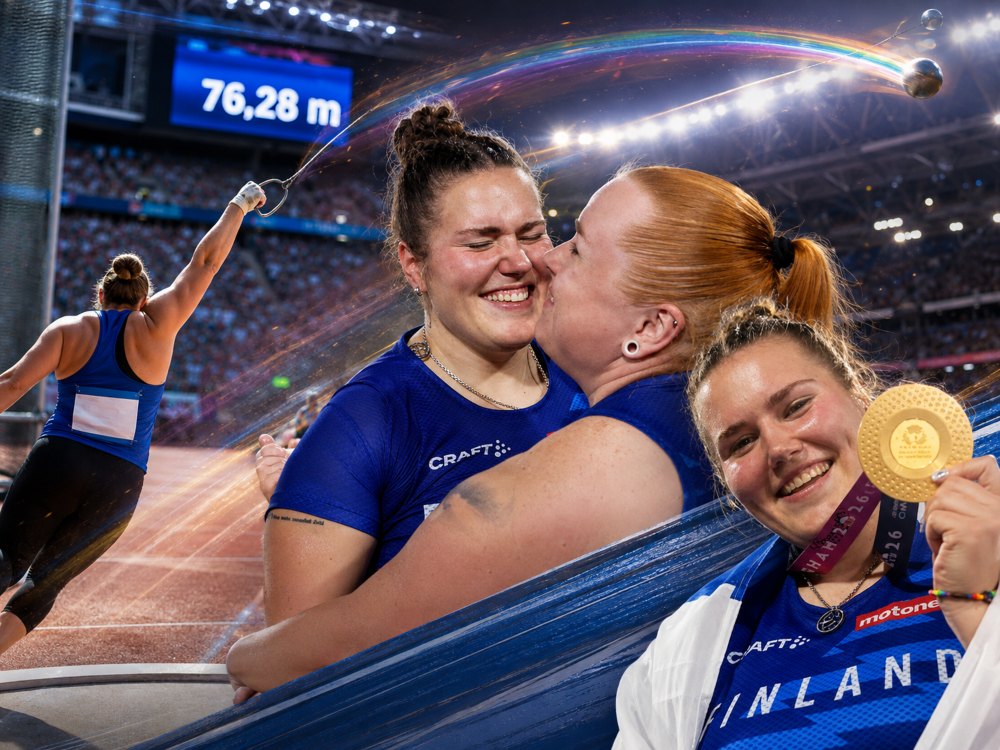
Finnish hammer thrower Silja Kosonen has celebrated the biggest victory of her career by sharing another deeply personal milestone — going public with her relationship with Finnish futsal player Senni Viren.
The 23-year-old claimed gold in the women’s hammer throw at the European Athletics Championships in Birmingham, producing a winning throw of 76.28 metres.
It was Kosonen’s first senior medal at a major championship and a history-making result for Finland, which had never previously won a European Championships medal in the women’s hammer.
Watching from the stands was Viren, a Finnish international futsal player — and the person Kosonen had already been imagining celebrating with if everything went right.
“I was already dreaming about the moment when I would be able to celebrate with her on the sidelines,” Kosonen said after her victory.
And when that gold-medal moment finally arrived, she decided there was no reason to hide her happiness.
‘I Have Found Another Person With Whom I Can Be Myself’
Kosonen and Viren began dating earlier this year after meeting in their hometown of Raisio in Finland.
Speaking after her European title, Kosonen described how much the relationship had changed her life.
“Since I met Senni at the beginning of the year, life has started to ‘smile’ in a different way,” she said.
“I have found another person with whom I can be myself.”
The couple had not planned a formal public announcement about their relationship during the championships.
Instead, Kosonen said the decision came naturally in the excitement of winning the biggest title of her career.
“We didn’t plan on making it public in any way in advance,” she later explained.
“I felt like I wanted to enjoy the moment and share the joy with others.”
For many LGBTQ+ people, there is something particularly relatable about that simplicity.
Rather than staging a dramatic coming-out announcement, Kosonen simply celebrated one of the happiest moments of her life with the person she loves.
An Overwhelmingly Positive Response
Kosonen said most of the reaction to her relationship becoming public had been supportive.
“Most of the messages have been really positive,” she said, while acknowledging that some negative responses had also appeared.
The couple have since shared their happiness publicly, bringing a new level of visibility to two athletes competing at elite level in Finnish sport.
For queer sports fans, that visibility can be especially meaningful.
LGBTQ+ women have historically been more visible in some sporting environments than gay and bisexual men, but coming out at the highest levels of competition can still carry uncertainty around sponsorship, media attention, teammates and public reaction.
Kosonen’s decision to share her relationship at the exact moment she reached the top of the European podium sends a particularly joyful message: professional success and living openly do not have to exist separately.
From Teenage Olympian To European Champion
Kosonen is already remarkably experienced for a 23-year-old.
She made her Olympic debut in Tokyo in 2021 when she was just 18, reaching the women’s hammer final.
She returned for the Paris Olympics in 2024, finishing fifth, and has continued establishing herself among the world’s leading throwers.
Her personal best stands at 77.07 metres, while her 2026 season has repeatedly placed her among Europe’s strongest athletes in the event.
Before Birmingham, however, a senior outdoor championship medal had continued to elude her.
That changed emphatically with her 76.28m throw.
Defending European champion Sara Fantini of Italy took silver with 74.35m, while Norway’s Beatrice Nedberge Llano claimed bronze with 72.88m.
Kosonen had finally turned years of near misses into gold.
A Significant Moment For Queer Visibility In Athletics
Coming out remains an intensely personal decision, and no athlete owes the public information about their sexuality or relationships.
But when elite athletes do choose to live openly, those moments can carry significance far beyond their own sport.
For younger LGBTQ+ athletes in particular, seeing a European champion casually celebrating with her girlfriend can offer something previous generations rarely had.
There is no conflict between being queer and reaching the highest levels of elite sport.
Kosonen does not have to choose between the athlete standing on top of the podium and the woman celebrating with her partner afterwards.
She gets to be both.
That ordinariness is part of what makes the moment powerful.
Looking Towards Los Angeles
At just 23, Kosonen has plenty of major competitions potentially ahead of her.
The Los Angeles Olympic Games in 2028 will naturally loom as a major target if she qualifies, potentially giving her the opportunity to compete at a third Olympics.
This time, however, she would arrive not only as an established international contender but as a European champion living publicly and openly.
For Kosonen, though, the most immediate memory from Birmingham may remain much simpler.
She threw further than every other woman in Europe.
She won the biggest medal of her career.
And when it was over, the person she wanted to celebrate with was waiting at the side of the track.