










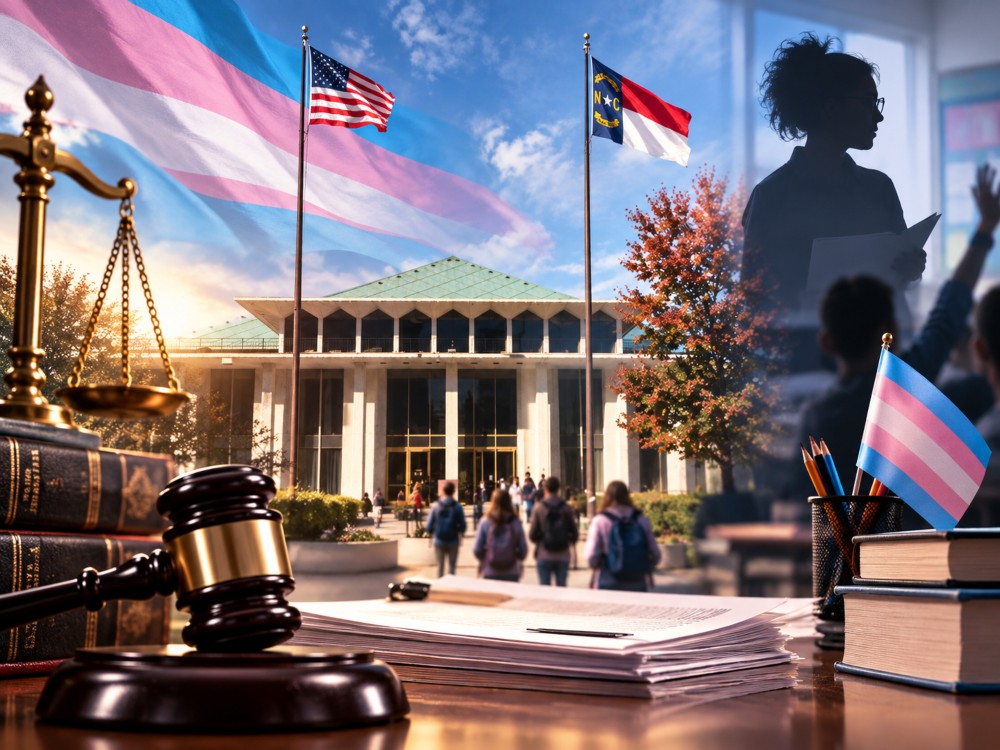

A US law firm is threatening to sue one of North Carolina’s largest school districts unless parents are allowed to remove their children from a class taught by a transgender teacher.
The Thomas More Society issued a formal demand to Wake County Public School System on 15 September, giving the district 15 days to meet a series of conditions before legal action is filed.
Those demands go well beyond curriculum.
The organisation wants parents to be allowed to opt their children out of the teacher’s class, wants students protected from discipline if they refuse to use the teacher’s pronouns, and is seeking assurances that the teacher will not use restrooms or locker rooms used by students.
It is also asking the district to guarantee that staff will not discuss sexuality or gender identity with students except where permitted by state law and with parental notice and opt-out rights.
The Teacher Is At The Centre Of A Wider Political Campaign
The dispute concerns an elementary-school music teacher in Wake County who is transgender.
The teacher’s hiring became the focus of political criticism over the winter, with Republican state representative Erin Paré publicly objecting to the appointment and describing the teacher as a “biological male” who dresses as a woman.
Paré later floated legislation that would require what she called “gender-appropriate professional attire” for public-school employees.
At school-board meetings, however, parents and community members have defended the teacher.
One parent said her children already knew and loved the educator, while another argued that the real source of confusion for students came from adults attacking people over their identity or appearance.
What The Thomas More Society Is Demanding
The Thomas More Society describes the case as one involving parental rights and religious freedom.
Its letter argues that some parents believe the teacher’s presence could lead to classroom discussion of gender identity, sexuality and transgender issues in ways that conflict with their religious beliefs.
The group is seeking several written assurances from the school district.
These include an opt-out from the teacher’s class, protection from discipline for students who use pronouns inconsistent with the teacher’s identity, restrictions on LGBTQ+-related discussion, and limits on the teacher’s access to facilities used by students.
The demands also seek protection for students and families from what the group describes as retaliation for opting out.
What The Law Actually Says
The Thomas More Society points to the US Supreme Court’s 2025 ruling in Mahmoud v. Taylor.
That case involved parents who objected on religious grounds to LGBTQ+-themed books being used in classroom instruction.
The Supreme Court ruled that parents had a right to opt their children out of those specific lessons.
But the decision did not establish that parents can automatically remove a child from a class simply because the teacher is LGBTQ+ or transgender.
That distinction is likely to be central if the Wake County dispute reaches court.
North Carolina’s Parents’ Bill of Rights separately prohibits instruction on gender identity and sexuality before fifth grade.
However, the law also states that answering a student’s unsolicited question does not count as formal instruction.
There is nothing in that provision that bans transgender teachers from working in elementary schools.
A Dispute About More Than Curriculum
The case highlights how quickly debates about classroom content can expand into questions about whether LGBTQ+ adults are allowed to simply exist in schools without their identity being treated as instructional material.
The Thomas More Society is arguing that some parents’ religious beliefs justify broad opt-outs and protections.
Supporters of the teacher say that position risks turning the mere presence of a transgender educator into something schools must treat as controversial or unsuitable.
That is a significantly different issue from whether a particular lesson or book conflicts with a family’s beliefs.
For LGBTQ+ advocates, the concern is that allowing opt-outs based on a teacher’s identity could create a precedent in which queer and trans employees themselves become grounds for exclusion.
The District Now Faces A Deadline
Wake County Public School System has until the end of the Thomas More Society’s 15-day deadline to respond to the demands.
If the district refuses, the organisation says it intends to file suit.
The legal fight could test how far recent Supreme Court protections for parental religious objections extend — and whether those protections apply to curriculum alone or can be stretched to the identity of the person teaching the class.
For now, the central fact remains simple:
The teacher has not been accused of misconduct.
The dispute exists because she is transgender.