









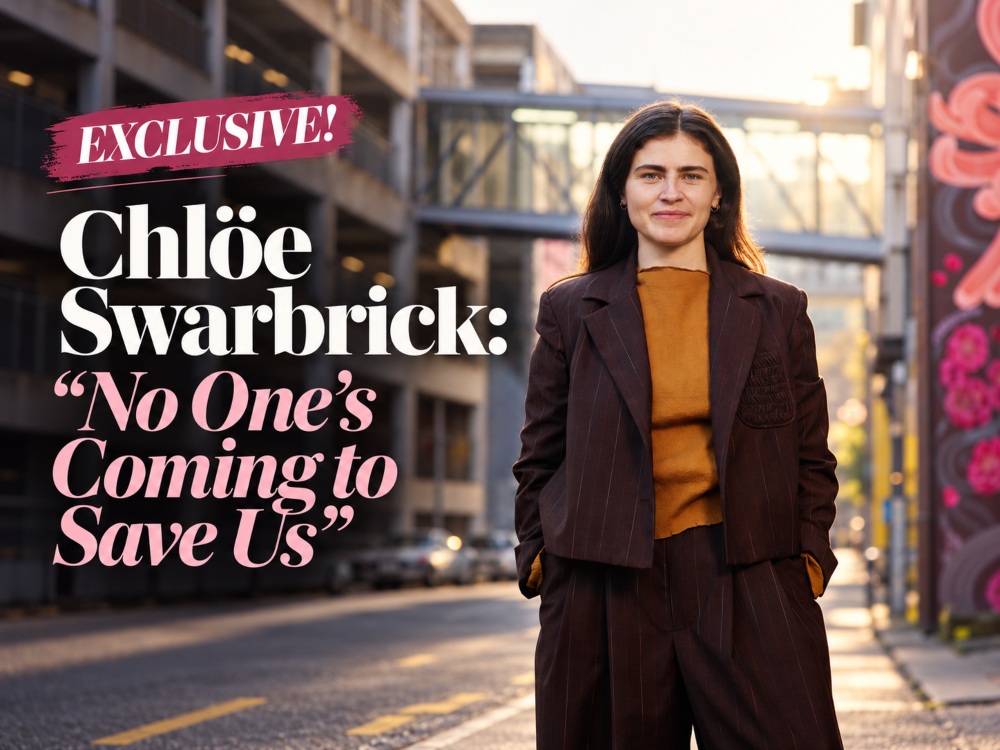

Green Party co-leader Chlöe Swarbrick tells YOUR EX’s Oliver Hall what 40 years of Homosexual Law Reform can teach us about the political battles ahead, why she believes politicians have overreached in transgender healthcare, and why coalition agreements are no excuse for compromising people’s dignity
“A new world is on her way.”
Chlöe Swarbrick is describing what she calls the “current political moment”, but her optimism comes with a warning.
“Every possible potential future is available to us right now,” the Green Party co-leader tells YOUR EX, acknowledging the exhaustion and anxiety many people feel about what that future might look like.
“This is the moment where we have to realise, no one’s coming to save us. We’re actually going to have to do this ourselves.”
Forty years on from Homosexual Law Reform, Swarbrick believes rainbow communities already have a blueprint for responding to difficult political times.
“Our community has so much whakapapa and history to illuminate our path ahead. While the fights might not look identical, the theory of change is the same. It’s going to require solidarity and people power.”
There is another ingredient she considers particularly queer: “Joy and pride and claiming space.”
“It can be a time where we claim that power and do so in a joyful way, which is why dancing is important!”
When YOUR EX points out that Swarbrick seems lighter and brighter than during our previous interviews and asks whether opposition might simply be easier than government, she laughs off the suggestion.
“Opposition is gnarly!”
Her mood, she says, has more to do with escaping Parliament for a day and spending time in her Auckland Central electorate.
“It’s why I do politics. If you see people doing good things, you understand our human nature, which is bizarrely anathema to the Westminster parliamentary system.”
She tells us her ambition is to “humanise” Parliament so that it more closely resembles the people it represents and encourages politicians to “compromise and collaborate”.
But compromise, in Swarbrick’s view, has limits.
One of her clearest examples is transgender healthcare.
The Greens have committed to reversing government restrictions on new puberty-blocker prescriptions for children and adolescents experiencing gender incongruence or gender dysphoria. The restrictions took legal effect in December 2025, although the Ministry of Health is currently not enforcing them while judicial review proceedings continue.
The Government has said its approach is precautionary, citing uncertainty in the evidence around benefits and risks. Swarbrick’s objection is fundamentally about who should be making the decision.
“Politicians with short-term political incentives and no real-world health expertise should not be making those very personal, individual healthcare decisions on behalf of New Zealanders.”
“That should be a decision made by healthcare practitioners.”
When YOUR EX raises ACT leader David Seymour’s expressed concerns about the rise in prescriptions and doctors’ judgement, Swarbrick argues that his position conflicts with the philosophy he applies elsewhere.
“Our community seems to be subjected to a very different set of rules and criteria than he would apply to almost everybody else.”
Her frustration intensifies when the conversation turns to New Zealand First’s Legislation (Definitions of Woman and Man) Amendment Bill.
The member’s bill proposes inserting definitions of “woman”, “female”, “man” and “male” into the Legislation Act, applying across legislation regardless of gender identity.
Swarbrick argues that preventing future Parliaments from attempting similar legislation would ultimately require broader constitutional reform and stronger entrenchment of rights.
What angers her more immediately is the explanation that supporting controversial legislation can simply be part of the price of governing under MMP.
“It’s not good enough for all of the MPs that voted for that just to say, ‘Sorry, this was the price of a coalition deal.’”
She argues elected MPs remain individually responsible for the consequences of the votes they cast.
“At a certain point, they have to reckon with the power and privilege that comes with being an elected representative.”
“They have to reckon with every trans, non-binary, takatāpui and gender-fluid member of the rainbow community they have thrown under the bus just so they can avoid having hard conversations with their coalition partners.”
Her conclusion is blunt.
“If you’re not standing up for the inherent dignity and mana of your fellow New Zealander, and you’re willing to sacrifice that at the altar of political convenience, and you don’t stand for anything, you’ll fall for nothing.”
That raises an obvious question for a party hoping to be part of the next government.
Labour leader Chris Hipkins told YOUR EX he was confident he would not allow prospective coalition partners to dictate policies he considered unacceptable. How realistic is that once the numbers around a negotiating table become tight?
Swarbrick rejects the idea that every concession made during coalition negotiations is equivalent. She argues there is a difference between negotiating over substantive policy choices and agreeing to proposals that she believes target minority communities.
She is also sceptical of the familiar idea that controversial decisions simply represent a minor coalition partner “wagging the dog”.
Swarbrick argues that arrangement can be politically convenient for everyone involved. A smaller party gets to claim ownership of a policy its supporters want, while the larger governing party can distance itself by suggesting it was simply the price of maintaining the coalition.
“Often it’s throwing a minority or structurally marginalised group of society under the bus, and writing that off as though it was apparently just one side of the coalition that wanted that.”
For Swarbrick, that does not remove responsibility from the MPs who ultimately vote for it.
She draws a distinction between those kinds of compromises and negotiations over policies such as tax reform, where parties may disagree substantially but are still negotiating over competing approaches to improving people’s lives.
It is also why she believes voters should have a fairly good idea what a Green presence in the next government would mean before coalition negotiations even begin.
“People know what the Green Party stands for. We’ve got a whole manifesto on how we’re going to support our rainbow communities.”
The Greens’ 2026 manifesto includes a dedicated Rainbow Communities platform covering healthcare, bodily integrity, safety, equality and community-led policy.
Swarbrick also points to an existing relationship with Labour. She and fellow Green Party co-leader Marama Davidson meet Hipkins formally each month and have other conversations in between.
She describes that relationship as “respectful and robust”.
And if the Greens are negotiating a coalition agreement after November, she promises one thing about its tone.
“Our coalition agreement is not going to look like a random grab bag of 200 of your uncle’s hot takes at Christmas.”
For all the discussion of Parliament, governments and coalition agreements, however, Swarbrick keeps returning to an idea that places less faith in politicians.
Forty years after rainbow New Zealanders successfully fought for Homosexual Law Reform, she sees history as a reminder that communities have more power than MPs.
“If we’re not happy with the state of political affairs, then, my friends, we’re going to have to step into the breach.”
And apparently, we should bring our dancing shoes.