








Communities across rural Ohio are responding with messages of support for LGBTQ+ families after billboards declaring that no child has two mothers or two fathers appeared throughout the state.
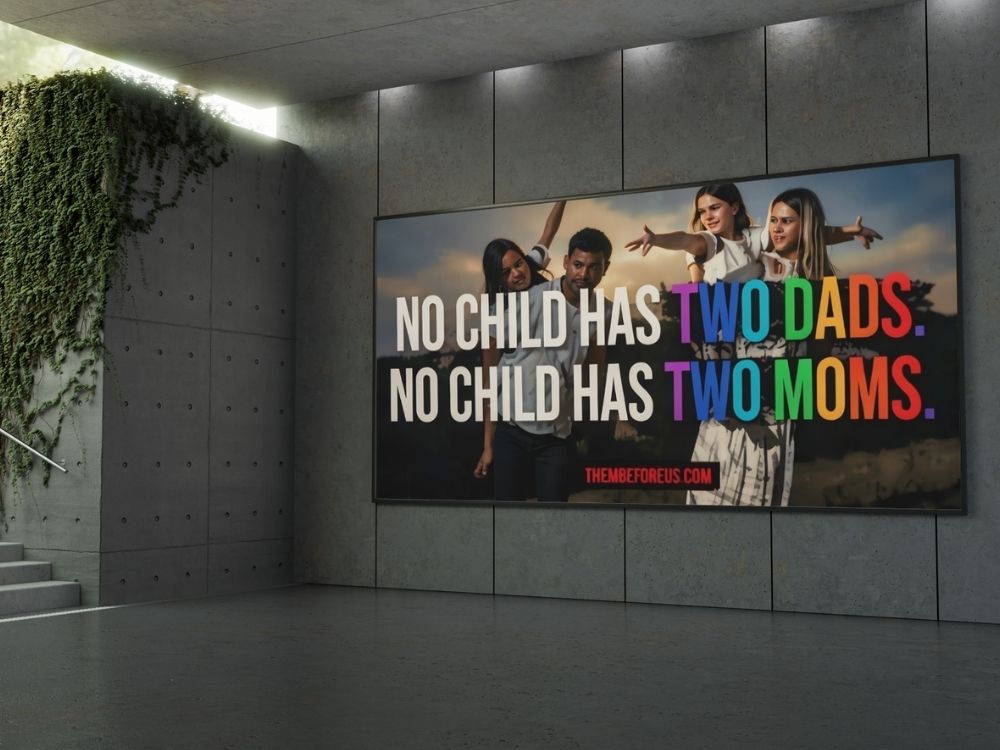
The advertisements, funded by Seattle-based organisation Them Before Us, state: “No child has two dads. No child has two moms.”
The words “two dads” and “two moms” appear in rainbow lettering, directly invoking same-sex parents while promoting the organisation’s belief that children should be raised by their biological mother and father.
Resident’s Post Brings Campaign to Wider Attention
The campaign attracted widespread attention after northwest Ohio resident Megan Tucker-Manly shared a photograph of one of the billboards on Facebook on 17 July.
Her post quickly went viral, receiving thousands of reactions and shares.
Tucker-Manly told The Buckeye Flame that the message did not affect only families headed by same-sex couples. She said it could also dismiss the experiences of children in foster care, blended families, divorced households and homes shaped by other circumstances.
Despite living with stage IV cancer, Tucker-Manly said she felt compelled to challenge the campaign publicly.
“I’m not sitting down, even though I should be the one to sit down because I have stage IV cancer and should be focused on other things,” she said. “Instead, this has just lit a fire [in me].”
LGBTQ+ Group Purchases Affirming Billboards
Dayton-based LGBTQ+ nonprofit Have a Gay Day responded by purchasing its own billboard space.
Its proposed design directly counters the original message, reading: “Many children have two dads. Many children have two moms.”
The organisation also began fundraising to keep its affirming advertisements displayed. By 23 July, the campaign had raised more than US$18,000.
Have a Gay Day subsequently announced a peaceful rally outside the City Building in Lima for 27 July.
“A peaceful rally will be held in front of the City Building in Lima at 50 Town Square Road at 6pm July 27th. Instructions are to bring positive signs of love and support for ALL families,” the organisation wrote.
The response turned an advertising campaign intended to promote one narrow model of family into a broader show of support for LGBTQ+ parents and children.
Advocacy Organisations Condemn the Message
Lima Pride Alliance and statewide advocacy organisation Equality Ohio also criticised the billboards.
Equality Ohio said the advertisements harmed many more people than the same-sex couples they appeared designed to target.
“These billboards don’t just attack LGBTQ+ families, they erase every Ohio kid whose home doesn’t fit a narrow, manufactured mould,” the organisation said.
A Human Rights Campaign spokesperson reportedly described the campaign as “disgusting” and “desperate”, while pointing to public polling indicating that most Ohio residents support marriage equality.
The billboards’ central statement also ignores the legal and everyday reality that children across the United States are raised by two mothers, two fathers, adoptive parents, grandparents, foster carers, stepparents and other family arrangements.
Them Before Us Opposes Marriage Equality
Them Before Us describes itself as a children’s rights organisation, but campaigns against marriage equality, assisted reproductive technologies including IVF and surrogacy, and no-fault divorce.
It argues that every child has a right to be raised by their married biological mother and father and that recognising same-sex marriages conflicts with that belief.
The organisation is also among 47 groups involved in the “Greater Than” campaign, launched in January 2026 to build support for overturning Obergefell v. Hodges.
The landmark 2015 US Supreme Court ruling established that the Constitution requires every state to license marriages between same-sex couples and recognise those legally performed elsewhere.
Them Before Us has published material describing the decision as harmful to children and supporting efforts to return control over marriage laws to individual states.
However, Obergefell remains in force. The federal Respect for Marriage Act also requires states and the federal government to recognise same-sex marriages legally performed in jurisdictions where they are permitted, even if the Supreme Court were eventually to reverse its 2015 ruling.
Campaign Produces the Opposite Response
Rather than quietly accepting the billboards, Ohio residents and LGBTQ+ organisations have used them to mobilise public support for diverse families.
The response has included viral social media posts, fundraising, counter-billboards and a peaceful community rally.
For Tucker-Manly, the campaign’s message was too harmful to ignore, even while she faced serious challenges of her own.
For Have a Gay Day and other advocacy groups, the answer was equally direct: children with two mothers or two fathers are not hypothetical, and their families deserve to be recognised rather than erased.