








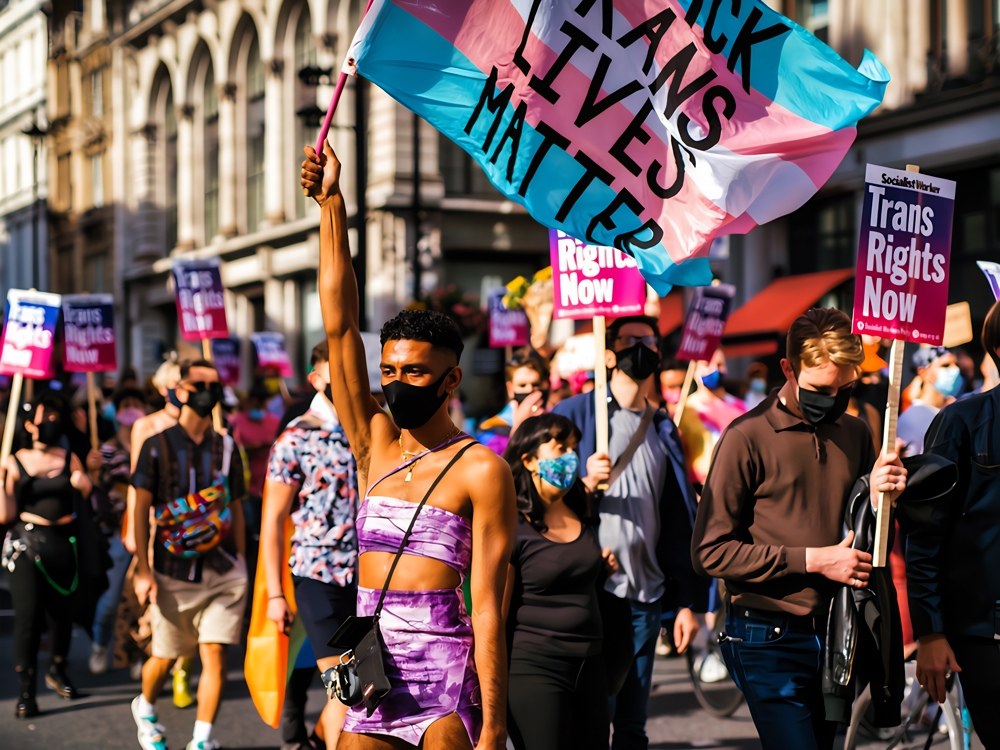
An estimated 150,000 people marched through central London on Saturday, 25 July, as the city’s Trans+ Pride event recorded what organisers described as the largest turnout for a trans-specific Pride march anywhere in the world.
The attendance figure, provided by London Trans+ Pride organisers, represents a significant increase from the more than 100,000 people reported at the 2025 event.
Marchers called for stronger protections for transgender people and protested against recent legal and policy changes affecting trans rights, healthcare and access to single-sex spaces.
March Ends in Trafalgar Square
The demonstration began near the BBC’s Broadcasting House in central London, where participants carried placards supporting trans healthcare, equality and community solidarity.
The procession travelled through the city before ending in Trafalgar Square for the first time in the event’s history.
Crowds filled the square’s steps and gathered around its fountains to hear speeches and performances beneath artist Teresa Margolles’ installation featuring casts of the faces of 726 transgender, non-binary and gender-nonconforming people.
London Trans+ Pride founding member Lewis G Burton said taking the event into the heart of the capital sent a powerful message about the community’s visibility and right to belong.
“Every single person who marched today is proof that we are not going anywhere, that our joy is louder than their hate, and that London Trans+ Pride will keep fighting, keep loving and keep growing until every trans person is safe, seen, and free,” Burton said.
Speakers and performers reportedly included Kae Tempest, Ceyenne Doroshow, Qween Jean and drag king Chiyo.
Protesters Challenge Single-Sex Spaces Guidance
Many demonstrators expressed anger over the Equality and Human Rights Commission’s updated code covering services, public functions and associations.
The changes followed the UK Supreme Court’s April 2025 ruling that the terms “sex”, “woman” and “man” in the Equality Act 2010 refer to biological sex. The court held that a Gender Recognition Certificate does not change a person’s sex for the purposes of the Act.
The revised code explains when trans people may be excluded from services corresponding with their gender, including changing rooms, hospital wards and some single-sex facilities.
A government equality assessment acknowledges that the changes could negatively affect trans people. It identifies potential consequences including involuntary disclosure, exclusion from both male and female spaces, increased harassment and difficulty accessing appropriate facilities.
Campaigners at the march argued that the guidance could make ordinary public life less safe and accessible for transgender people.
Caroline Litman Warns of Further Deaths
Caroline Litman, a former NHS psychiatrist and co-founder of parent advocacy organisation Transparent Action, attended in memory of her daughter, Alice.
Alice Litman died by suicide in May 2022 at the age of 20 after spending 1,023 days waiting for her first appointment with an NHS gender service.
A coroner later concluded that lengthy waits and barriers to gender-affirming healthcare had contributed to a decline in Alice’s mental health.
Caroline Litman said her family had made Alice’s inquest public in the hope of preventing similar deaths but believed conditions had continued to deteriorate.
“Things have got so much worse, and it’s just so disappointing because my family chose to go public with (Alice’s) inquest in an effort to raise awareness of the terrible wait lists and to really bring about change, and it’s just got worse and worse and worse since that happened, and it’s just so disappointing,” Litman said.
She called on Prime Minister Andy Burnham to reverse policies introduced under his predecessor, Sir Keir Starmer.
“Andy (Burnham), if you’re listening, I’m the mother of a trans child who took her life by suicide and more children are going to die on your watch if you don’t do something to reverse the anti-trans policies that your predecessor has overseen.
“This is telling you loud and clear: it will happen, and you will be responsible.
“More and more research is coming through every week, every month, to show that gender-affirming care is life-saving care, especially in under-18s.”
Burnham became UK prime minister on 19 July, less than a week before the march, after succeeding Starmer.
“Our Joy Is Louder Than Their Hate”
London Trans+ Pride was established in 2019 amid growing concern about discrimination and hostility towards transgender people in Britain.
Its continued growth reflects both the increasing visibility of the trans community and mounting anxiety about healthcare restrictions, political rhetoric and changes to equality guidance.
Organisers said the record crowd demonstrated that trans people and their allies would continue demanding safety, dignity and equal participation in public life.
The march combined protest with celebration, filling central London with trans flags, music and messages of collective resistance.
For Burton, its message was unmistakable: the community is not disappearing, retreating or surrendering its place in the city.