









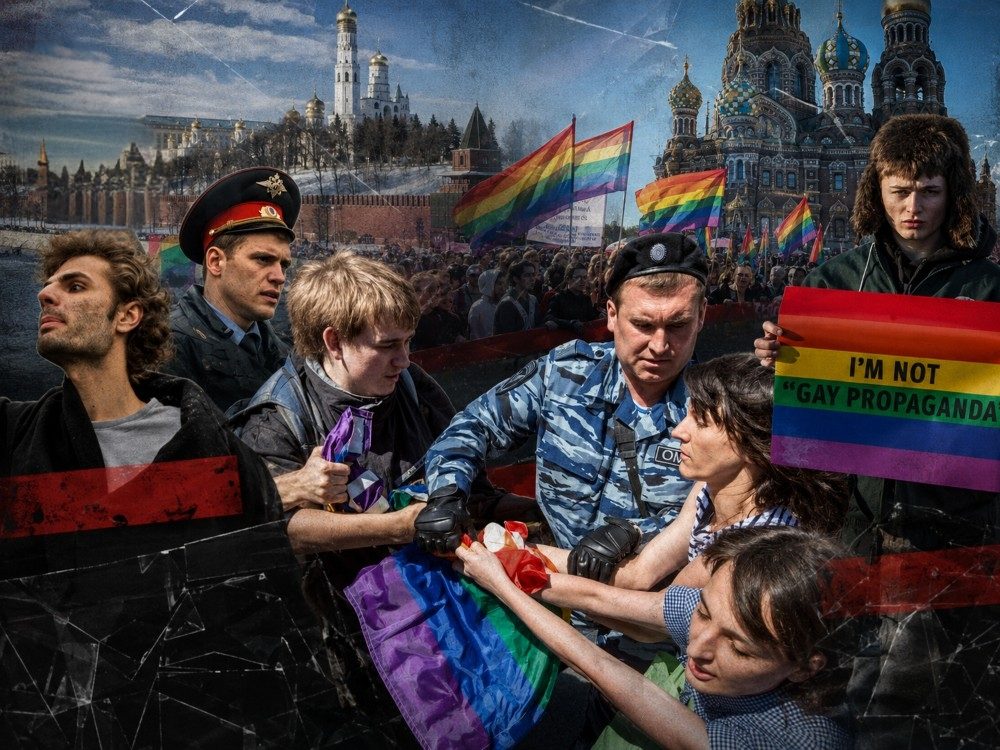
One of Russia’s most prominent LGBTQ+ rights organisations is shutting down after being designated an “extremist organisation”, saying continuing its public work would put staff, supporters and people seeking help at unacceptable risk.
The Russian LGBT Network confirmed the decision in a statement on 17 August, ending nearly two decades of public advocacy, crisis support and community work.
The closure follows an April ruling by the St Petersburg City Court, which granted a lawsuit brought by Russia’s Justice Ministry and banned the organisation as “extremist”.
For the Network, the consequences were clear.
“Any connection to the organisation may create additional risks for the people we seek to support and protect,” it said.
The organisation said it had made the decision only after carrying out a serious assessment of the dangers facing those linked to its work.
“Continuing our public work could endanger those who took part in the organisation’s activities, supported it, or received help from it,” the Network said.
“We can’t control the repressive environment, but we can do everything possible to avoid creating additional risks for people. People’s safety comes first.”
Nearly 20 Years Of LGBTQ+ Support
Founded in 2006, the Russian LGBT Network became one of the country’s best-known organisations supporting lesbian, gay, bisexual, transgender and other queer people.
Over the years, it connected regional activists, provided legal and psychological assistance, supported people experiencing discrimination and helped LGBTQ+ Russians facing immediate danger.
The organisation became internationally known during the anti-gay purges reported in Chechnya from 2017 onwards, when queer people were detained, tortured and, in some cases, reportedly killed.
The Network helped coordinate evacuations and assistance for people trying to escape persecution.
Its work also extended far beyond emergency situations.
For LGBTQ+ Russians living in an increasingly hostile legal and political environment, the organisation provided something increasingly difficult to find: a visible national network offering practical support and the reassurance that queer people were not alone.
That public presence has now become too dangerous to maintain.
Russia’s Expanding ‘Extremism’ Crackdown
The Russian LGBT Network’s closure follows years of tightening restrictions on LGBTQ+ people under President Vladimir Putin.
In November 2023, Russia’s Supreme Court declared the vaguely defined so-called “international LGBT movement” an extremist organisation.
No such formal organisation actually existed, but the ruling gave authorities sweeping powers to target LGBTQ+ activism, symbols, organisations and public expressions of solidarity.
Since then, people have faced fines, arrests and criminal prosecution for activities authorities associate with LGBTQ+ identities.
Rainbow flags and other LGBTQ+ symbols have been treated as potential extremist material, while organisations providing support to queer communities have faced escalating legal pressure.
The Russian LGBT Network itself was one of nine LGBTQ+ groups banned as “extremist” by courts across seven regions between March and May 2026.
Among the organisations targeted were groups providing legal assistance, health information, crisis services, community support and LGBTQ+ journalism.
Human-rights advocates say the effect is not simply to close individual organisations but to make any form of organised queer community life increasingly dangerous.
Support Organisations Are Being Forced Underground Or Abroad
Other Russian LGBTQ+ groups and media organisations have also faced similar pressure.
Coming Out, another major LGBTQ+ rights organisation, was declared extremist by a St Petersburg court earlier this year.
Parni+, one of the largest Russian-language LGBTQ+ media and health platforms, was also targeted, while journalists and activists have increasingly been forced to operate from outside the country.
Some organisations have chosen to continue working remotely from exile.
For groups still connected directly with people inside Russia, however, the risks are considerable.
An “extremist” designation can expose people associated with an organisation to investigation or prosecution, meaning even donating, volunteering, sharing information or seeking assistance can become dangerous.
That creates an especially devastating problem for LGBTQ+ people already facing violence, discrimination or family rejection.
The organisations most capable of helping them are increasingly being criminalised themselves.
A Decade Of Escalating Anti-LGBTQ+ Laws
Russia’s current crackdown did not begin with the 2023 extremism ruling.
In 2013, the government introduced its so-called “gay propaganda” law, initially banning the distribution of information about LGBTQ+ relationships to minors.
The restriction was dramatically expanded in 2022 to cover people of all ages, effectively banning positive or neutral public representations of LGBTQ+ identities across media, advertising, entertainment and other areas of public life.
Russia has also introduced sweeping restrictions affecting transgender people, including bans on most legal gender recognition and gender-affirming medical care.
The 2023 Supreme Court ruling pushed those restrictions further by allowing ordinary LGBTQ+ organising and visibility to be framed through the language of extremism.
That shift has turned what were already severe restrictions into potential criminal cases carrying far more serious consequences.
Real Prison Sentences Are Now Being Handed Down
The risks are no longer theoretical.
In June 2026, a Russian court sentenced the owner and two employees of the Pose nightclub in Orenburg to prison under the 2023 “LGBT movement” extremism ruling.
The club’s owner received a seven-year sentence, while two staff members were also imprisoned.
The convictions demonstrated just how far the government’s interpretation of the ruling can extend.
A venue associated with queer nightlife was effectively treated as part of an extremist organisation.
For LGBTQ+ Russians, the case sent a stark message: community spaces once viewed primarily through the lens of censorship or “propaganda” rules can now expose people to lengthy criminal sentences.
What The Closure Means For LGBTQ+ Russians
The loss of the Russian LGBT Network is about much more than one organisation disappearing.
For almost 20 years, it functioned as a bridge between activists, lawyers, health workers, volunteers and LGBTQ+ people across an enormous country.
Its closure removes another visible point of contact for people seeking legal advice, psychological support, crisis assistance or simply community.
It also creates a chilling effect.
If engaging with an LGBTQ+ organisation can be interpreted as association with extremism, people may think twice before asking for help at all.
That isolation is precisely what human-rights groups fear Russia’s policies are designed to achieve.
Human Rights Watch has said authorities are increasingly criminalising those who provide support to LGBTQ+ people and has called for the extremist rulings to be overturned.
Amnesty International has similarly described the measures as part of a wider campaign of persecution against LGBTQ+ people and organisations.
A Community Being Forced Out Of Public Life
The Russian LGBT Network says shutting down is ultimately an act of protection.
Continuing publicly could put the very people it was created to help in greater danger.
That reality illustrates how profoundly LGBTQ+ life in Russia has changed.
An organisation that spent nearly two decades providing support is not closing because the need for its work has disappeared.
It is closing because providing that support openly has itself become dangerous.
For LGBTQ+ communities in Aotearoa New Zealand, the development is another reminder that queer rights can never be taken for granted.
Visibility, community organisations and access to support may feel ordinary in places where those freedoms are protected.
In Russia, those same things are increasingly being treated as evidence of extremism.
The Russian LGBT Network may be ending its public work, but the people who depended on it have not disappeared.
If anything, their need for safe support has only become greater.