







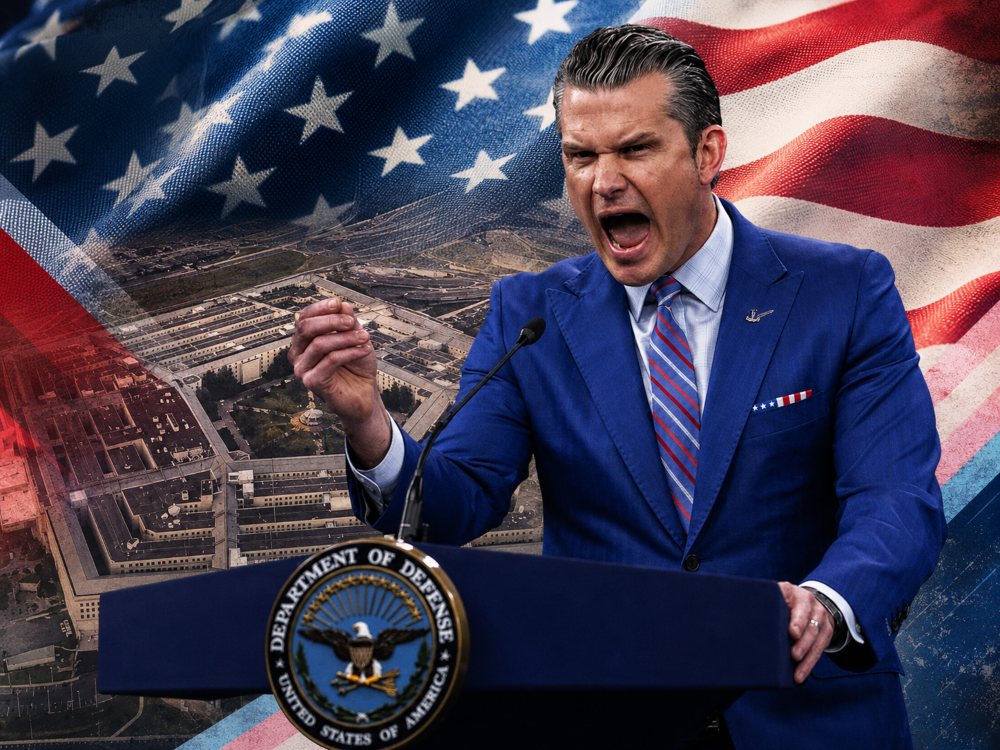

US Defence Secretary Pete Hegseth has drawn criticism after using an anti-transgender slur during a public appearance at the Iowa State Fair.
Hegseth made the remark on 17 August while appearing alongside Republican congressman Zach Nunn at Operation Top Nunn: Salute To The Troops, an annual veterans and fundraising event held at JR’s SouthPork Ranch.
During his speech, Hegseth referred to the Pentagon using the Trump administration’s preferred secondary name, the “Department Of War”, before saying:
“At the Department Of War, we do training, not t******.”
The slur, historically used to demean transgender people, was delivered as Hegseth outlined his vision for the US military.
He continued by saying the department should focus on “training, lethality, accountability, discipline” and readiness, describing those qualities as the foundations of an American service member.
Hegseth also characterised his approach as “colourblind, gender-neutral, merit-based”.
The contrast between describing the military as “gender-neutral” while using a derogatory term for transgender people has drawn particular attention from LGBTQ+ advocates and media.
Hegseth Continues His Attack On DEI
Hegseth used the appearance to celebrate the Trump administration’s rollback of diversity, equity and inclusion initiatives across the military.
Since returning to office, President Donald Trump and senior administration officials have repeatedly framed DEI policies as incompatible with military effectiveness.
Hegseth has become one of the administration’s most vocal proponents of that argument, frequently linking military readiness with the removal of programmes focused on diversity and inclusion.
At the Iowa event, he presented those changes as part of a broader effort to reshape military culture around what he described as merit and combat effectiveness.
Critics, however, argue that the administration’s use of “merit-based” language has frequently accompanied policies directly targeting minority groups, including transgender service members.
What Is The ‘Department Of War’?
Hegseth’s repeated use of “Department Of War” is part of another Trump administration branding change.
In September 2025, Trump authorised the Department of Defence and its officials to use Department Of War and Secretary Of War as secondary titles.
The change allows Hegseth and other officials to use the terminology publicly.
However, the department’s legal name remains the Department of Defence.
Changing that formally would require congressional action.
Trump has said he prefers the older “War” terminology because he believes it better reflects the military’s purpose and America’s history.
Transgender Service Members Have Been A Major Target
Hegseth’s language comes against the backdrop of sweeping restrictions on transgender people serving in the US military.
Early in Trump’s second term, the administration moved to exclude transgender people from military service and restrict gender-affirming healthcare within the armed forces.
The policy has faced extensive legal challenges.
Courts have questioned whether the restrictions amount to unconstitutional discrimination, while litigation over the policy continues.
For transgender service members, the consequences are not simply rhetorical.
The administration’s policies have affected careers, healthcare, enlistment and the ability of people who have already served for years to remain in uniform.
Against that backdrop, LGBTQ+ advocates argue that a sitting defence secretary publicly using an anti-trans slur risks reinforcing hostility towards the very service members affected by those policies.
A Sitting Defence Secretary Using A Slur Matters
Political arguments about who should be permitted to serve in the military are one thing.
Using derogatory language about an entire group of people is another.
The word Hegseth used has long been recognised as a slur against transgender people.
Its use by one of the most senior officials in the US government is therefore significant, particularly when that official directly oversees policies affecting trans military personnel.
Language from political leaders can shape how minority communities are treated far beyond the walls of government.
When a derogatory term is used casually from a stage — and receives laughter or applause — it can help normalise language transgender people have spent decades being targeted with.
For LGBTQ+ communities in Aotearoa New Zealand, the incident also offers a reminder that debates about transgender rights in the United States are increasingly being fought not only through legislation and regulation, but through the language political leaders choose to use.
The Wider Culture-War Campaign
Hegseth has built much of his political profile around opposition to what he describes as “woke” culture within the military.
His tenure has included moves against DEI programmes, restrictions affecting transgender personnel and repeated criticism of policies intended to broaden diversity within the armed forces.
Supporters argue those changes restore focus to military readiness and standards.
Critics say the policies instead use military institutions as another arena for a wider conservative culture war, with LGBTQ+ people and other minorities increasingly singled out.
The Iowa speech did little to separate those two debates.
Hegseth presented his anti-DEI agenda, military priorities and a slur targeting trans people as part of the same vision for the armed forces.
For transgender Americans serving, hoping to serve or simply watching from outside, that message was difficult to miss.