








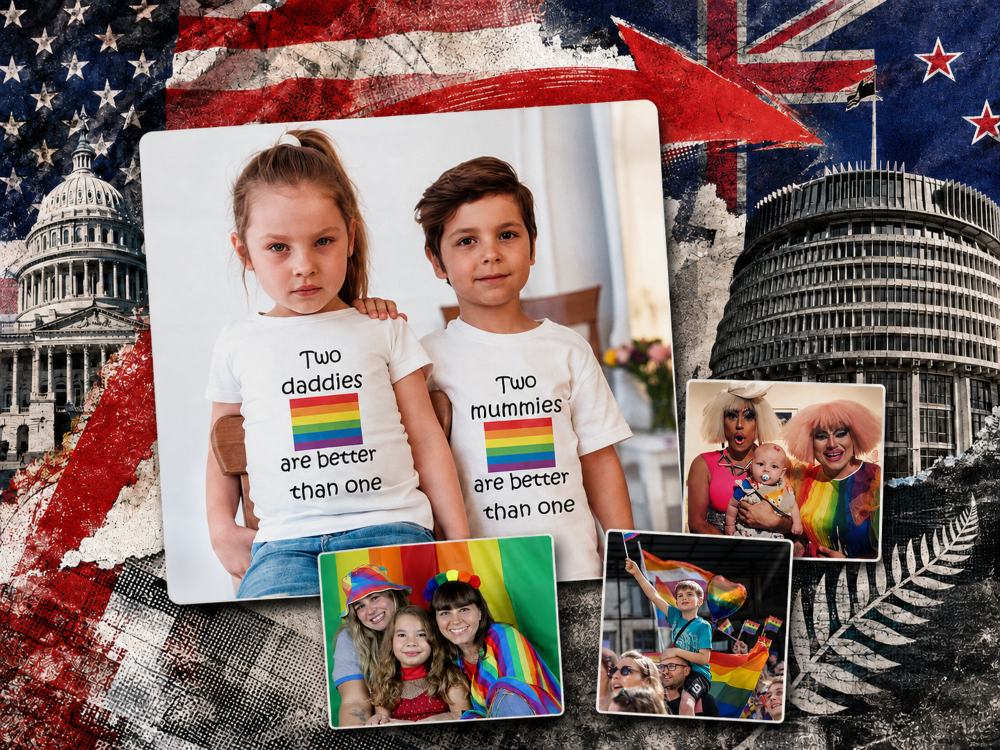
Family First NZ has reignited criticism from rainbow communities after sharing a US campaign claiming children cannot have two mothers or two fathers.
In a recent Facebook post, the conservative lobby group praised an “excellent campaign” from American organisation Them Before Us.
The accompanying graphic declares: “No child has two dads. No child has two moms,” while Family First adds: “Every child has both a mother and a father, that is undeniable.”
But the claim relies on deliberately blurring the distinction between biological reproduction and parenthood.
A child may be conceived using an egg and sperm, but that does not mean every child is raised by one mother and one father.
Adoptive parents are parents. Stepparents can be parents. Foster parents, grandparents and whānau caregivers may raise children. Rainbow families can include two mums, two dads, single LGBTQ+ parents, donor-conceived children and a much wider network of loving caregivers.
Pretending those families do not exist does not change reality.
It simply erases them.
New Zealand Already Recognises Rainbow Parents
Family First’s claim is also inconsistent with the legal reality of modern Aotearoa.
New Zealand law has recognised same-sex parents for years.
Women in same-sex relationships can both be legally recognised as parents in donor-conception circumstances, while marriage equality has allowed married same-sex couples to jointly adopt children.
Birth registration rules were also updated in 2024 so parents can choose whether they are recorded as a mother, father or parent.
The change was explicitly designed to better recognise the diversity of New Zealand families, including families with two mums.
Children with two mothers or two fathers are therefore not hypothetical, ideological or the invention of campaigners.
They are New Zealanders growing up in families that already exist and are legally recognised.
Research Does Not Support The Claim
Family First’s messaging also implies that children need one male and one female parent in order to thrive.
That conclusion is not supported by the weight of available research.
A 2023 systematic review and meta-analysis published in BMJ Global Health examined dozens of studies comparing children raised in sexual-minority families with those raised by heterosexual parents.
Most family outcomes were similar between the groups.
Some measures, including psychological adjustment and parent-child relationships, were even more favourable among rainbow families.
The broader body of international research has reached much the same conclusion: the sexual orientation of a child’s parents is not, by itself, a meaningful predictor of poor development.
What matters far more are factors such as stability, safety, economic security, quality of relationships and the support available to children and caregivers.
Research into rainbow families is not without limitations. LGBTQ+ families are diverse, sample sizes can be smaller, and family structures differ significantly.
But those limitations do not support a sweeping claim that two mums or two dads are inherently harmful.
If anything, studies have repeatedly identified something else as a genuine risk to rainbow families: stigma.
That includes public messaging telling children that their parents are not real.
When ‘Biology’ Becomes A Political Talking Point
The slogan works by reducing parenthood to reproduction.
But society does not apply that definition consistently anywhere else.
Nobody tells an adopted child that their adoptive parents are not really their parents because they did not provide the egg or sperm.
Nobody insists that a grandparent raising a child is somehow less meaningful because they were not part of conception.
And few people would argue that a biological parent who has never raised or cared for their child automatically has a stronger claim to parenthood than the person who has loved, protected and supported that child every day.
Families are built in many ways.
Biology can be part of that story, but it is not the only thing that makes someone a parent.
Even the Graphic Appears Manufactured
The campaign’s presentation is almost as questionable as its message.
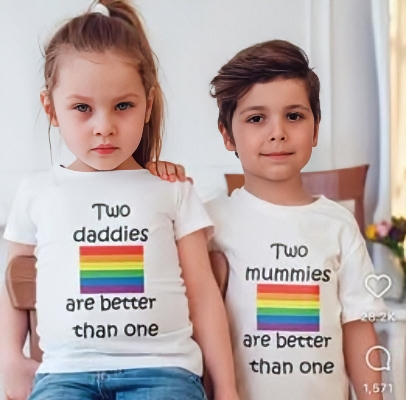
Rather than showing one of the original American billboards, Family First’s post appears to feature a crudely altered digital mock-up of two children wearing white shirts. The phrases “two daddies” and “two mummies are better than one” seem to have been digitally superimposed onto the image. The rudimentary editing is immediately noticeable, giving the graphic a distinctly manufactured appearance and raising further questions about how the campaign’s message is being presented.
An American Culture War Arrives In Aotearoa
Them Before Us is a US organisation founded by Katy Faust, who has campaigned against marriage equality and advocates for a family model centred around biological mothers and fathers.
Its “No Child Has Two Dads” campaign has appeared on billboards in the United States and has prompted strong responses from LGBTQ+ communities.
In Ohio, local residents and rainbow organisations responded to the campaign by fundraising for counter-billboards supporting LGBTQ+ families.
By sharing the messaging in New Zealand, Family First is importing a distinctly American culture-war argument into an Aotearoa context where rainbow families have long been part of everyday life.
The organisation has a long history of campaigning against LGBTQ+ law reform, including marriage equality and policies supporting transgender people.
Family First also lost its charitable registration following a lengthy legal battle.
In 2022, the Supreme Court unanimously concluded that the organisation no longer qualified for charitable status, finding that its activities did not meet the required standard for advancing education in a balanced charitable sense.
Rainbow Families Do Not Need Permission To Exist
There is room for legitimate discussion about parenting, children’s wellbeing and how governments should support families.
But pretending that families with two mums or two dads simply do not exist is not a serious contribution to that conversation.
Rainbow families are already part of schools, workplaces, neighbourhoods, marae and communities across Aotearoa.
They celebrate birthdays, pack school lunches, help with homework, sit through Saturday morning sport and worry about their children just like everyone else.
Their children do not benefit from being told that the people raising them somehow do not count.
The available evidence does not show that having two mums or two dads harms children.
What it does show is that love, stability, support and acceptance matter.
The families are real.
The misinformation is not.